Programs
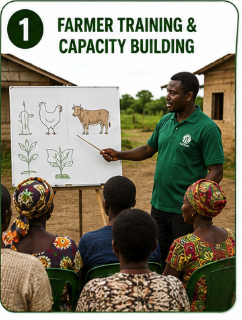
Farmer Training & Capacity Building
Knowledge is one of the most valuable resources a farmer can possess. GADF provides practical, hands-on training designed to improve agricultural productivity, profitability, and sustainability.
Training Areas
- Poultry production; pig farming; goat and sheep production; cattle management; fish farming; and crop production.
- Farm business management, agricultural entrepreneurship, financial literacy, farm record keeping, and cooperative development.
- Feed formulation, animal nutrition, biosecurity, disease prevention, and Good Agricultural Practices (GAP).
- Post-harvest handling, value addition, and agribusiness management.
Expected Outcomes
- Increased productivity and food production.
- Lower production costs and improved farm management.
- Better animal health and stronger production performance.
- Higher farm incomes and more resilient enterprises.
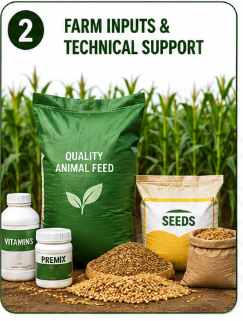
Farm Inputs & Technical Support
Many farmers struggle because they lack access to quality agricultural inputs and professional advice. GADF works to bridge this gap by providing technical support throughout the production cycle.
Services
- Livestock feed, feed additives and premixes, veterinary medicines, and vaccination support.
- Farm inputs, seed sourcing, fertilizer recommendations, and farm planning.
- Farm visits, advisory services, animal-health support, and production monitoring.
- Feed-formulation guidance and business advisory support.
Benefits
- Improved farm performance and increased yields.
- Reduced mortality, healthier animals, and better feed efficiency.
- Improved profitability through timely, informed production decisions.
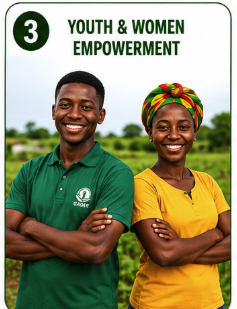
Youth & Women Empowerment
Young people and women play a critical role in agricultural transformation. GADF equips them with practical skills, leadership capabilities, and business opportunities to build sustainable livelihoods.
Programme Components
- Agribusiness entrepreneurship training, business incubation, skills development, leadership training, and mentorship.
- Financial literacy, savings and investment education, digital agriculture, and start-up support.
- Cooperative formation and support for income-generating activities.
Focus Areas
- Poultry enterprises, vegetable production, and livestock farming.
- Food processing, agribusiness services, and agricultural marketing.
Expected Impact
- Youth employment and reduced rural unemployment.
- Women’s economic empowerment and increased household incomes.
- New and sustainable agribusiness start-ups.
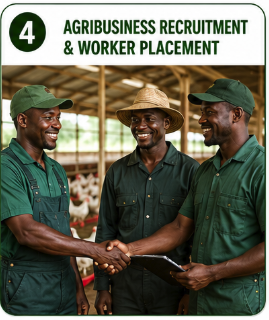
Agribusiness Recruitment & Worker Placement
Agricultural businesses often struggle to find skilled and reliable workers, while many trained individuals seek employment. GADF serves as a bridge between employers and qualified workers.
Services
- Worker recruitment, farm-labour placement, farm-manager recruitment, and agribusiness staffing.
- Skills assessment, worker orientation, workforce training, employer support, and labour management.
Positions Supported
- Farm managers, farm supervisors, poultry attendants, livestock workers, and general farm workers.
- Tractor operators, feed-mill workers, sales personnel, and agribusiness officers.
Value to Employers and Job Seekers
- Employers gain access to trained workers, reliable staffing solutions, and lower recruitment costs.
- Job seekers gain employment opportunities, skills development, career growth, and professional support.
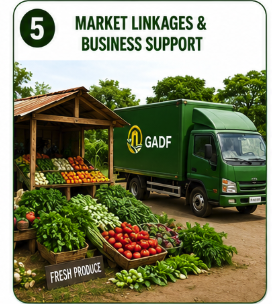
Market Linkages & Business Support
Producing quality agricultural products is only part of the journey. Farmers also need reliable markets where they can sell at profitable prices. GADF helps farmers become market-oriented businesses.
Services
- Buyer linkages, contract-farming facilitation, market information, value-chain development, and business networking.
- Cooperative development, product marketing, investment readiness, and business planning.
- Branding support, packaging advice, and financial management.
Market Connections
- Wholesalers, retailers, agro-processors, exporters, hotels, and restaurants.
- Supermarkets, feed manufacturers, and institutional buyers.
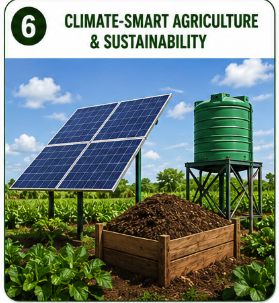
Climate-Smart Agriculture & Sustainability
Climate change poses significant challenges to agriculture. GADF promotes environmentally responsible farming practices that increase productivity while protecting natural resources.
Activities
- Climate-smart farming, sustainable agriculture, soil conservation, water management, and agroforestry.
- Circular agriculture, agricultural-waste utilization, compost production, and carbon-smart farming.
- Renewable-energy adoption, environmental conservation, and climate-adaptation training.
- Carbon Readiness Programme
- Support farmers to adopt climate-smart practices and improve farm data collection.
- Help measure environmental impacts and reduce greenhouse-gas emissions.
- Build readiness for emerging carbon-finance opportunities.
Expected Outcomes
- Reduced environmental impact and improved soil health.
- Greater climate resilience and sustainable agricultural production.
- Better long-term farm profitability.
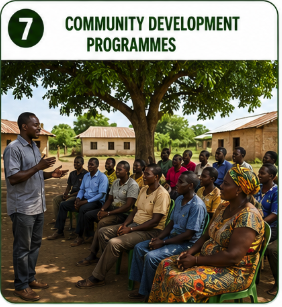
Community Development Programmes
Agricultural development must improve entire communities, not only individual farmers. GADF works with local communities to implement integrated initiatives that strengthen livelihoods and resilience.
Programme Areas
- Food-security initiatives, nutrition education, community farming projects, and rural livelihood improvement.
- Water and sanitation support, school agriculture programmes, youth development, and women’s empowerment.
- Community training, farmer organizations, disaster resilience, and local economic development.
Expected Impact
- Reduced poverty and improved nutrition.
- Increased household income and better livelihoods.
- Stronger communities and sustainable rural development.
Cross-Cutting Themes
Every programme is designed through an inclusive and sustainability-focused lens. These themes guide programme planning, delivery, partnership, and learning:
- Gender equality and social inclusion.
- Youth participation and leadership.
- Climate resilience and environmental sustainability.
- Innovation, technology, and digital agriculture.
- Financial inclusion.
- Partnerships and collaboration.
- Local economic development.